PBM Complaint Systems in Practice: Where Pharmacies and Regulators Disconnect

PBM oversight laws are expanding across the country, but the complaint systems designed to enforce them often reveal a disconnect between how pharmacies document reimbursement problems and how regulators review them.
Across the United States, pharmacies are increasingly utilizing Maximum Allowable Cost (MAC) appeals, external appeals, and state complaint processes when reimbursement leaves the pharmacy underwater on a prescription or otherwise under-reimbursed for the drug dispensed. Legislatures in many states have enacted statutes intended to improve transparency and create oversight of pharmacy benefit managers (PBMs).
However, in practice, many pharmacies and regulators are encountering a significant operational gap in how these complaint systems function. While pharmacies are filing complaints to document reimbursement issues tied to specific prescriptions, the agencies responsible for reviewing those complaints may approach the process from a broader regulatory perspective. This difference in approach can create confusion, frustration, and, in some cases, a lack of confidence in the oversight system itself.
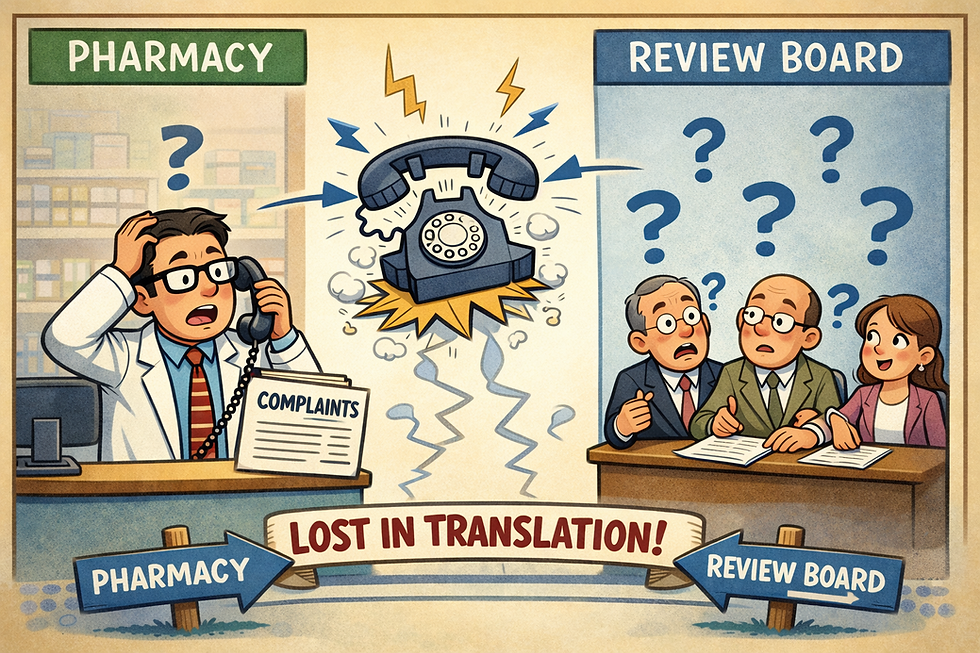
Claim-Level Complaints vs. Program-Level Review
Pharmacies experience reimbursement issues at the individual claim level. Each complaint typically corresponds to a specific prescription filled, a reimbursement amount received from the PBM, and the applicable pricing benchmark used within that state.
Depending on the state, reimbursement standards may be tied to benchmarks such as:
Pharmacy acquisition cost
National Average Drug Acquisition Cost (NADAC)
Average Acquisition Cost (AAC)
State-specific MAC pricing standards
Because reimbursement discrepancies occur one prescription at a time, pharmacies frequently submit complaints tied to each affected claim. These complaints are not intended to overwhelm regulators but rather to document the real-world reimbursement outcomes that occur in the marketplace.
Regulatory reviewers, however, may be looking for a small number of complaints that demonstrate a broader systemic issue. When agencies receive a high volume of claim-level complaints, the submissions may be interpreted as repetitive or administratively burdensome rather than as evidence of a pattern of reimbursement practices.
This difference in perspective can make it difficult for both sides to fully understand the intent and value of the complaint process.
The Documentation Challenge
Another challenge arises from how pharmacies submit supporting documentation.
Some pharmacies submit extensive documentation packages that include multiple invoices, wholesaler reports, pricing screenshots, internal notes, and claim history records. While the intent is to provide as much evidence as possible, excessive documentation can make it difficult for reviewers to quickly identify the core reimbursement issue.
Conversely, other complaints lack the critical documents needed for an effective review. Missing materials may include:
The pharmacy’s acquisition invoice or pricing documentation
The PBM’s MAC appeal response
Confirmation of product availability or sourcing efforts
Claim identifiers necessary for investigators to locate the transaction
Without these materials, regulators may not have enough information to follow up on the complaint or request corrective action.
A clear understanding of what documentation is necessary—and what is not—can significantly affect how efficiently complaints are reviewed.
Complaints as the Foundation for Enforcement
In recent years, state regulators and federal agencies have begun taking a more active role in investigating pharmacy benefit manager practices. Across the country, audits, lawsuits, consent orders, and financial penalties are increasingly being used to address PBM conduct.
For example, several states have conducted audits or issued enforcement actions involving major PBMs such as CVS Caremark, Express Scripts, and OptumRx. These actions have addressed issues ranging from reimbursement practices to operational compliance with state PBM oversight laws.
These developments reflect a broader shift toward stronger regulatory oversight of pharmacy benefit managers. However, audits and enforcement actions rarely occur in isolation.
In many cases, complaints and claim-level documentation submitted by pharmacies provide the data regulators rely on to identify patterns of PBM behavior.
When multiple pharmacies report similar reimbursement issues, regulators gain insight into whether a problem represents:
an isolated claim dispute
a repeated operational failure in the appeals process
or a broader compliance issue affecting pharmacies statewide.
Without that claim-level information, it becomes significantly harder for regulators to detect systemic issues within PBM reimbursement practices.
Why Pharmacy Participation Matters
Filing complaints can sometimes feel administrative or repetitive for pharmacies, particularly when the issue involves a single prescription. However, those individual complaints collectively create the evidence needed for meaningful oversight.
Each documented claim helps regulators understand how reimbursement policies function in practice.
Over time, this information can contribute to:
state audits of PBM operations
regulatory investigations
consent orders and corrective action
financial penalties for violations of state law
legislative reform efforts aimed at improving transparency and accountability.
In other words, the complaint process is not just about resolving a single prescription reimbursement dispute. It is also one of the primary ways regulators gain visibility into how PBM practices affect pharmacies and patients across the state.
The Confidence Gap
Perhaps the most concerning issue emerging across multiple states is a growing hesitation among pharmacies to file complaints at all.
Some pharmacies question whether the reviewing agency fully understands the mechanics of drug reimbursement. Others worry that filing complaints will require significant administrative effort without producing a meaningful outcome.
When pharmacies lose confidence in the complaint process, potential violations may go unreported. At the same time, regulators lose access to valuable information that could help identify broader patterns within PBM reimbursement practices.
Effective oversight systems depend on participation from the stakeholders they are designed to protect. If pharmacies disengage from the process, the regulatory framework becomes significantly less effective.
Turning Complaint Data Into Oversight
As PBM oversight continues to evolve, one thing is becoming increasingly clear: enforcement actions rarely begin with a single complaint. Instead, they often emerge after regulators see repeated patterns across multiple claims, pharmacies, or regions.
This is why claim-level documentation matters. Individual complaints may seem small in isolation, but collectively they provide regulators with the visibility needed to identify broader compliance concerns.
When pharmacies document reimbursement issues, include clear supporting documentation, and submit complaints through the appropriate regulatory channels, they contribute to a larger body of information that can inform audits, investigations, and enforcement actions.
At the same time, regulators benefit from clearer documentation standards and a stronger understanding of how pharmacy reimbursement disputes arise in daily practice.
Bridging this operational gap is essential.
The Path Forward
The growing number of PBM audits, enforcement actions, and regulatory reviews across the country signals that oversight is moving into a new phase. Legislatures have established the legal framework, and regulators are increasingly using those authorities to examine PBM practices.
For that system to function effectively, pharmacies and regulators must work from a shared understanding of how reimbursement disputes are documented, reviewed, and escalated.
Pharmacies provide the real-world data. Regulators provide the authority to investigate and enforce the law. When those two pieces align, the complaint process becomes more than an administrative step—it becomes a meaningful mechanism for accountability.
Strengthening that connection will be essential as states continue working to ensure that pharmacy reimbursement systems operate transparently, fairly, and in accordance with the laws designed to protect both pharmacies and the patients they serve.
Every complaint filed is more than a single claim dispute—it is part of the data that allows regulators to see how reimbursement policies function in the real world.
About the Author
Kayla Copeland, founder of LJA Consulting, where she works with independent pharmacies nationwide to navigate PBM reimbursement disputes, MAC appeals, and state regulatory complaint processes. Her work focuses on translating pharmacy operational data into structured documentation that supports regulatory review and oversight of pharmacy benefit manager practices.
Through initiatives such as the M.O.M. Manual (MAC Operational Manual) and collaborative efforts with Pharmacy Marketplace, she works to improve how pharmacies document claim-level reimbursement issues and how regulators interpret that information during complaint reviews, audits, and enforcement actions. Her efforts are aimed at strengthening transparency, accountability, and communication between pharmacies and state oversight agencies in PBM reimbursement systems.


Comments